

Cain carries on centuries of family whiskey-making at Nobeltons Distilling House
Lest you think Cain is some radical spirits maker, know that his grain choices and fermentation techniques are rooted firmly in family traditions. For more than a century, his family has used its own heirloom varietal born of Canadian rye “that’s similar to a brasado rye.

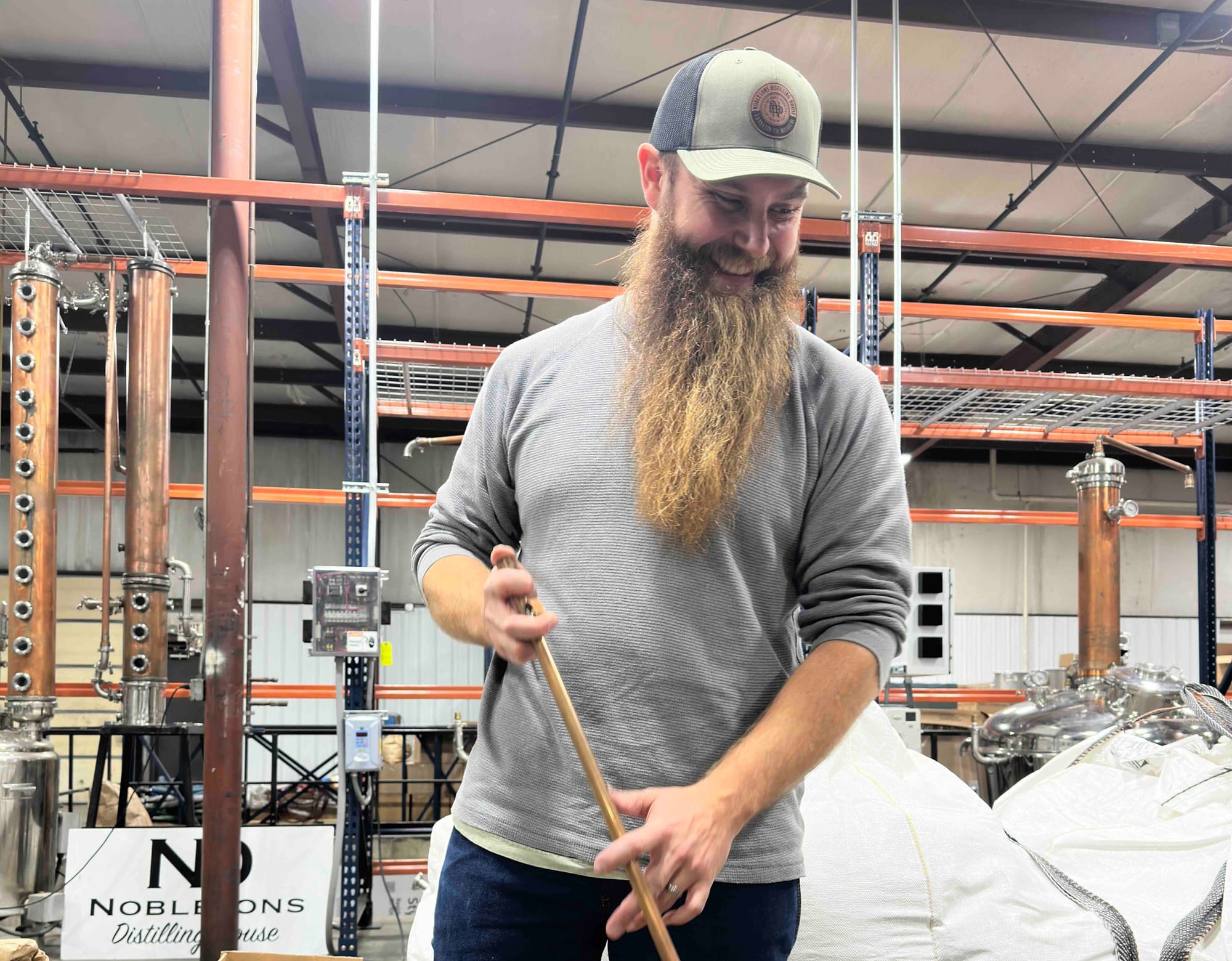
This is the second in a series of four stories about BourbonBanter.com’s trip to Missouri for a glimpse of its burgeoning whiskey-making industry.
If you’re not familiar with the term “estate distilling,” apply this acronym to understand it: Not just DIY, but DEY. Do everything yourself.
For Nobletons Distilling House cofounder and distiller, Demitrius Cain, that means choosing, planting and harvesting heirloom grains used by his Scottish immigrant family for nearly two centuries.
It means commissioning coppersmiths to create custom vacuum stills in the Armagnac style.
People think we’re crazy to do it this way.
But we love it. It’s a family thing.
This is a generational thing.
We get to do a lot of cool stuff.
It includes driving from Missouri to Iowa to get used dairy tankers no longer fit for milk hauling, trucking them back to Missouri and fabricating them to become temperature-controlled beer fermenters.
It also means it’s on him to see that everything is distilled, bottled and then marketed on a shoestring budget.
And then, contrary to his vision of being a farmer-distiller only, it meant creating an event space in Union, MO, for fans of his products to visit, celebrate and consume his good work. (Turns out he’s really glad he did that.)
Clearly, estate distilling means abundant hard work and investment without any of the fancy connotations of “estate.”
“People think we’re crazy to do it this way,” said Cain, winning the unannounced prize for Understatement of the Day. “But we love it. It’s a family thing. This is a generational thing. We get to do a lot of cool stuff.”
Not quite a TED Talk promo snippet, but an honest and endearing assessment of life in the Cain family, which includes him, his wife, Laura, and their four children living in a remote 850-square-foot farmhouse. That Cain smiles often and articulates his lifestyle and career choice with such ease surely is part of his liquor company’s wide appeal.
“I’m curious about a lot of stuff, and when you own the business, you get to experiment a lot.”
But cheering for the ever-grinding underdog just because he’s fun to hang with goes only so far. A company’s whiskies have to be good, and Cain delivers on his brand promise with several fine examples—not to mention experiments with agave spirits, vodka, rum and curacao.
“I’m curious about a lot of stuff,” he began. “And when you own the business, you get to experiment a lot.”
Lest you think Cain is some radical spirits maker, know that his grain choices and fermentation techniques are rooted firmly in family traditions. For more than a century, his family has used its own heirloom varietal born of Canadian rye “that’s similar to a brasado rye. … It’s 100 percent malted rye … and by malting all of it, I would say (our rye whiskey) has more fig and raisin notes.”
He maintains that rye is the first truly American whiskey, “and I know a lot of you know people will contend with that,” he added, grinning at a group of whiskey reporters. “But we've got journals that go back to the 1800s, when my family was distilling rye under other families … in Virginia and Kentucky.”
Regarding his nine family mash bills, one made of 51 percent sweet corn, 45 percent rye and 4 percent malted barley was used by his family as early as 1836 and up until Prohibition.
Eager to be nearer to Laura’s family, the Cains put down roots in Missouri. When talk of reviving his family’s distilling business began, Cain made it a reality on his farm in 2016 where he cooks, ferments and distills the bulk of his spirits. A smaller still set is used in the same building housing the visitor center.
Stills on his farm are based on the construction of France’s Armagnac stills. By creating a vacuum within the still, he can boil the beer at 82 F versus 175 F to extract ethanol. Cain said that creates richness that’s visible as legs that form within a swirled glass of spirit and a viscous mouthfeel.
Cain uses low-temperature, long fermentation cycles similar to lagering to create flavor complexity.
“We do 48-day fermentations,” he said. “It’s really fermenting for 14 days, and then we lager for 36. After 14 days it's done fermenting, but if you just let it lager like beer (at 41 F), by the time it comes out, it tastes more like a barley wine.
“We really chase our texture while some people chase aromas and other characteristics. I chase texture, because if you have more oils, those flavors and characteristics of the congeners carry better across the palate, in my opinion.”
Since he uses only malted grain—-yeah, he malts it himself—and no additional enzymes, he acknowledges that his rate of starch conversion to alcohol is three to five ABV points below the industry standard. But he’s fine with that.
“Where others are shooting for 10% to 12%, we’re getting a maximum of 7% alcohol,” he said. “We know we lose that alcohol, but we’re not using anything artificial.”
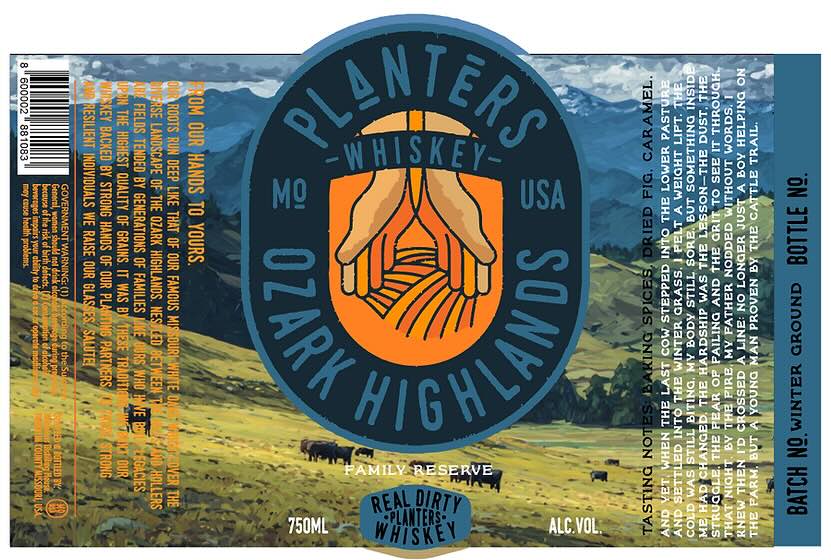
His crusade for purity also aligns with Missouri’s certification as an Ozark Highlands spirit, which must be produced, aged for four years in Missouri-made barrels, proofed down with the area’s water and then bottled in the state’s Ozark Highlands region. His own Planters Ozark Highlands Whiskey and Copper Dome Whiskey bear that claim on their labels.
“I don't consider myself a master distiller. Really, I'm barely a head distiller,” he said. “Some days, I'm just a steward for my family's history and trying to carry forward the tradition. But, really, the reason we're here is because of the people that support us. Most companies forget that. They own your brand as much as you own it. We owe them a place to come and enjoy the whiskey with us.”