

Life’s short, so drink your whiskey wisely, and have fun
Full abstinence from alcohol isn't essential, says Feldhaus. An occasional consumer of beer and wine in the company of friends and with food, he balances alcohol’s drawbacks and its benefits.

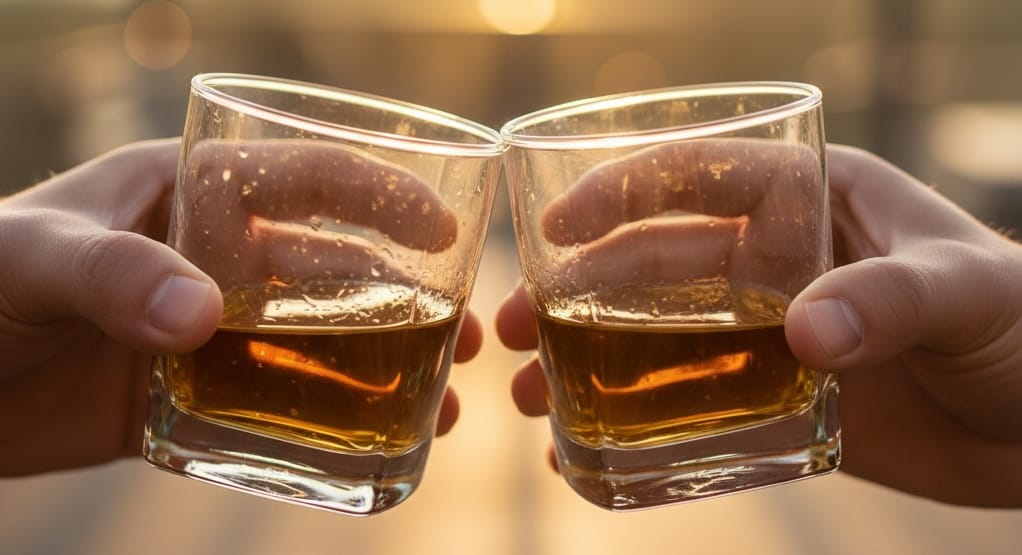
Recently I read a commentary titled, “I’m a longevity doctor. This is why I’ll never give up alcohol.” When I finished, I copied and emailed it to myself with the subject line, “The most balanced article on alcohol consumption I’ve ever read.”
Written for The Telegraph by Dr. Simon Feldhaus, chief medical officer of The Balance Rehab Clinic’s Swiss hub, and president of the Swiss Society for Anti Ageing Medicine and Prevention (SSAAMP), Feldhaus has focused on longevity for 15 years.
Feldhaus doesn’t buy the increasingly popular, but by no means majority opinion, that full abstinence from alcohol is essential for a long life. Self-described as an occasional consumer of beer and wine in the company of friends and with food, Feldhaus’s words range from frank takes on alcohol’s drawbacks to its positive social benefits.
But overall, he says “(S)pending time eating, drinking, laughing and swapping stories (while drinking) has brought me much pleasure over the years, so I have no plans to stop.”
Isn’t that how most adults who consume beverage alcohol view that practice? We enjoy it in the company of others. We enjoy it at celebrations as significant as weddings and as simple as the Friday coda to a long work week. We enjoy it during a round of golf or around a campfire. Readers of this website enjoy its endless flavors, the brand stories behind them and the stories told when alcohol is shared.
For most drinkers, alcohol also is refreshing and delicious, especially when consumed with food. While our foods are generally savory and sweet, alcohol maneuvers easily between each with more bitter, herbal and spicy characteristics.
As Feldhaus points out, fermentation is as natural a chemical reaction as any in nature. And kudos to those humans who figured out at least four millennia ago how to benefit from this metamorphosis of sugar into alcohol by turning it into pleasing beverages. Alcohol “is not an alien substance” in our bodies, he writes.
As a Christian who reads the Bible regularly, I see clearly the role of wine in ancient agriculture and societies. Many scripture passages show it consumed in celebration whether for a good harvest, the consummation of a treaty or, most notably, at the wedding feast at Canaan, where Jesus performed his first miracle by turning water into wine. (Imagine the Wine Spectator score on that wine!)
Sadly, some of the most disastrous events portrayed in the Bible center on drunkenness that led to madness, maiming, marriages breaking and, tragically, wars. Even more troubling is the fact that negative outcomes mentioned in scripture far outnumber those in which wine is portrayed favorably. But if you ask me, the Bible is clear on the matter: Enjoy alcohol, but don’t overdo it. And if that doesn't move your moral needle, don't forget that Jesus made it and drank it.
“(T)here’s no excuse for abusing our bodies,” Feldhaus writes “While I’m not suggesting that alcohol is necessary, or risk-free, I do believe that our relationship with it is more nuanced than the current fear-driven narrative it’s become fashionable to push.”
That narrative is neo-prohibition, a movement inflamed by The World Health Organization’s claim that there is no safe amount of alcohol to drink.
“There’s no excuse for abusing our bodies,” Feldhaus writes. “There’s no escaping the fact that alcohol is a toxin, with no essential biological role in the human body.
But “(S)o much of modern medicine is motivated through fear. Fear of food, fear of alcohol, fear of life. Three decades of being a doctor, however, has taught me that of all the emotions humans experience, fear itself is the most toxic for the body.”
Perhaps the most eye-opening bit Feldhaus mentioned was this:
“And from a toxicological perspective, alcohol is not the most demanding substance the liver processes—not even close,” he began. “Many commonly prescribed medications place a far greater burden on liver enzymes. Statins, blood pressure drugs, anticoagulants and sleeping pills are all foreign chemicals that require complex detoxification and often compete for the same liver enzymes to do this. Add grapefruit juice, supplements or multiple prescriptions, and these detox pathways can be inhibited. Yet we rarely warn patients about this complexity. Instead, we tell them: ‘Never drink a glass of wine.’
“The liver of a person who drinks one glass of wine per month but takes three medications every day may be under far more strain than someone who drinks moderately (as I do) and who (like me) isn’t on medication. This is not an argument for drinking, but just offering some perspective.”
While reading his comments, I Googled a few questions about alcohol consumption that leads to problems, and here’s a summary of what I found: Depending on the reporting source, between 10% and 15% percent of alcohol consumers become alcoholics or, in the modern and tortured parlance, sufferers of alcohol use disorder.
You don’t have to be a math whiz to see that at least 85% of those who drink alcohol don’t become addicted to it—which makes prohibition of it absurd, especially in light of Feldhaus’s research into genetics and alcohol. Our genes, he writes, strongly influence how much booze we can handle.
- Each person's liver is different from another's, and that matters.
- The body’s detoxification capacity is highly individual.
- Our livers use enzymes to process alcohol safely, and while most people produce those enzymes efficiently, others don’t and others can’t produce them at all.
“(T)oxicity, in biology, is never a simple yes-or-no question. It is always a question of dose,” he writes. “After all, eight liters of water can kill you, and even oxygen becomes toxic at the wrong concentration. Almost nothing in nature is harmless in unlimited quantities, and alcohol is no different. … However, when looking at the root cause of diseases, it is never only down to someone’s alcohol intake. An individual’s broader nutritional intake, physical activity and lifestyle patterns also have an impact.”
Feldhaus goes on to describe his alcohol consumption as “deliberate.”
“Never in front of the television, never to relax or to escape or when I’m stressed. … A glass of wine consumed anxiously, alone, as self-medication has a very different physiological impact than the same glass shared over a meal with friends. The context in which we drink actually changes biology.”
That was a “Wow!” moment for me since I do sometimes drink alone and in front of a TV. I love people, so neither is my first choice. But if my wife is out of town and I can watch a history documentary she’d not like, then I’ll do it with a cocktail in hand. And I know countless drinkers who love a drink while reading a great book in silence.
I’d bet Feldhaus would cast those infrequent habits into the “nuances” category since they’re occasional indulgences. To me, fearful or sorrowful isolation is different from a moment of solitary and quiet consumption after the kids go to bed.
But what I loved most about his commentary was the closer.
“There is one exception in the year when I throw caution to the wind happily,” he writes. “During the annual German beer festival Oktoberfest, I enthusiastically—and unashamedly—enjoy drinking beer by the litre. Because life is too short not to have fun.”
At our annual Bourbon & Banter Summit, drinking with each other at our evening bottle shares is always rated the favorite among our events. Distillery tours are fun and informative, but engaging with old and new friends over whiskey pours is the biggest reason for our fall gathering in Louisville. Like Feldhaus, we know that life is too short not to have fun. He chooses beer and wine, and we choose whiskey.