

How Do You Like These Apples? — A Cautionary Tale for Brands Who Can't Handle Honest Reviews
So no, we're not keeping this one quiet. When someone drags one of our people through the mud in front of an audience, we're going to respond. Not out of spite. Not to manufacture drama. But because staying silent has a cost too, and we've already paid it once.


I'll be honest. This one stings a little.
Not because we're not used to brands pushing back on reviews. We are. It comes with the territory. Fifteen years of honest reviews means fifteen years of occasionally telling someone their baby isn't as pretty as they think it is. Most of the time, the people behind those brands handle it like professionals. They reach out privately, they ask questions, sometimes we talk it through. Occasionally, they just go quiet and stop sending samples. That's fine. We understand.
What we don't expect is a brand owner going on LinkedIn and essentially calling one of our contributors an idiot.
That's what happened here.
Steve Coomes reviewed the Tamworth Garden VSOP Apple Brandy. He received the sample, disclosed it, and did something many reviewers don't bother to do: he pulled four other apple brandies off his own shelf to check his palate. He wasn't having a bad day. He wasn't being lazy. He did the work. His conclusion was that the spirit didn't present the apple character he expected, particularly given that Tamworth's own website describes the product as having barrels "packed with New Hampshire apple flavor." That's a direct quote from their page, not something Steve invented.
His verdict? Bar, not bottle. Not a bust. Not "this is terrible." Just: I'm not getting the fruit character I expected, and at $75, that matters.
Steven Grasse, the founder of the company that makes this brandy, responded publicly on LinkedIn (5/28 @ 3:07 pm update: It appears that it appears that Steven Grasse has removed the post from Linkedin)." He compared Steve's expectation of apple flavor to wanting it to taste like a Mott's juice box. He told us to stick to reviewing bourbon.
Yeah. I'm looking at you, Steven Grasse.
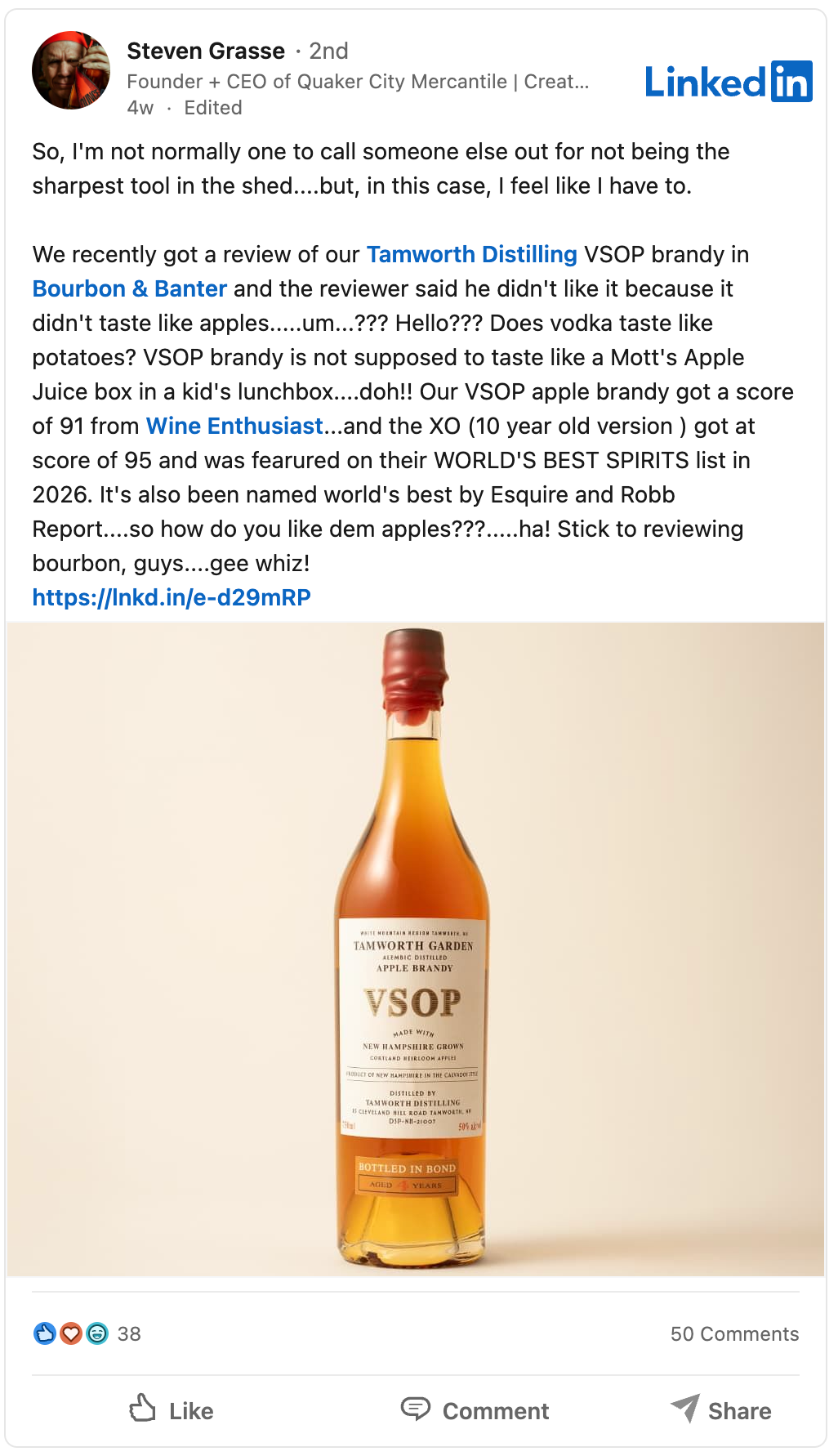
Here's the thing. If you have a legitimate concern about a review, there's a right way to handle it. Pick up the phone. Send an email. Say, "Hey, I read this. I've got some questions. Can we talk?" That's what professionals do. That's what most brands do. We've had those conversations. Sometimes we find out there was a bad bottle. Sometimes we just don't agree, and we part ways respectfully. That's the deal when you send out samples with "no strings attached" — and those are the exact words in the disclaimer on the review itself.
What you don't do is take it to social media, misrepresent what the review actually said, and invite a pile-on from people who clearly hadn't read it. The comments were full of people dunking on Steve for saying something he never actually said.
Now, I realize there's a certain irony in me writing this on our own website. I'm essentially saying "don't go public" while going very much public. I get it.
And I'll be honest: that's not always been my instinct. There was a time when my default was to keep things quiet, smooth it over, and avoid making a bad situation worse. I thought that was the mature move. Looking back, I'm not sure it was. Someone on our team deserved better than my silence, and I've had to sit with that. It's a lesson that took longer than it should have to learn, and one that I think about more than she probably realizes.
So no, we're not keeping this one quiet. When someone drags one of our people through the mud in front of an audience, we're going to respond. Not out of spite. Not to manufacture drama. But because staying silent has a cost too, and we've already paid it once. The people who read our work deserve to know what happened and decide for themselves.
Fair warning to anyone else considering that route.
I've seen bad brand behavior before. Early in our run, we reviewed bottles from a well-known series. Liked some, didn't like others, said so plainly. Nobody reached out. The samples just stopped coming. Fine. That's a quiet way of saying you didn't like the feedback. No hard feelings.
There was another situation that was worse. We had two contributors post reviews of the same bottle, reaching similar conclusions with different wording. The chairman of that bottle's company found both reviews. When he came across the man's review, he reached out and thanked him. Good review, appreciated it. When he found the woman's review, which came to the same review conclusion albeit with more direct words, he went after her aggressively on social media. I reached out as the publisher. Asked what was going on. Asked for an apology. He came at me instead. Threatened legal action. The whole thing was a nightmare. Eventually, the day-to-day guy stepped in, smoothed things over as much as he could, and told me the chairman wasn't the type to apologize. That's just how he did business.
That chairman isn't with us anymore. The guy who cleaned up the Chairman's mess has moved on to bigger and better things, and we continue to have a good relationship. I'm not saying that's karma. (Well. Maybe a little.)
The point is this: how you treat people leaves a mark. It leaves a mark on us, on your reputation with other reviewers, and on how your brand sits with readers who are paying attention.
Steve's review was fair. More than fair. He complimented the craftsmanship, acknowledged the barrels' quality, and left the door open for other palates to reach a different conclusion. He wasn't cruel. He wasn't reckless. He was honest, which is the only thing we've ever promised anyone who reads this site.
As we head toward fifteen years of doing this, here's where we stand. If we get something factually wrong, tell us, and we'll fix it. If you have a concern, reach out privately, and we'll have a conversation. But if your move is to go public and call our people dumb for giving you an honest review, don't be surprised when we respond in kind.
Steve Coomes doesn't owe anyone an apology.
Steven Grasse does.