

New King of Kentucky Small Batch: 3 proofs, 12-18 year bourbons
What’s so appealing about King of Kentucky is that while mostly traditional bourbon notes are expressed in it, all are turned up to 11. That makes it one my favorite bourbons ever. It’s liquid goodness amplified by time, heat-cycled warehouses and a caretaker’s patience.

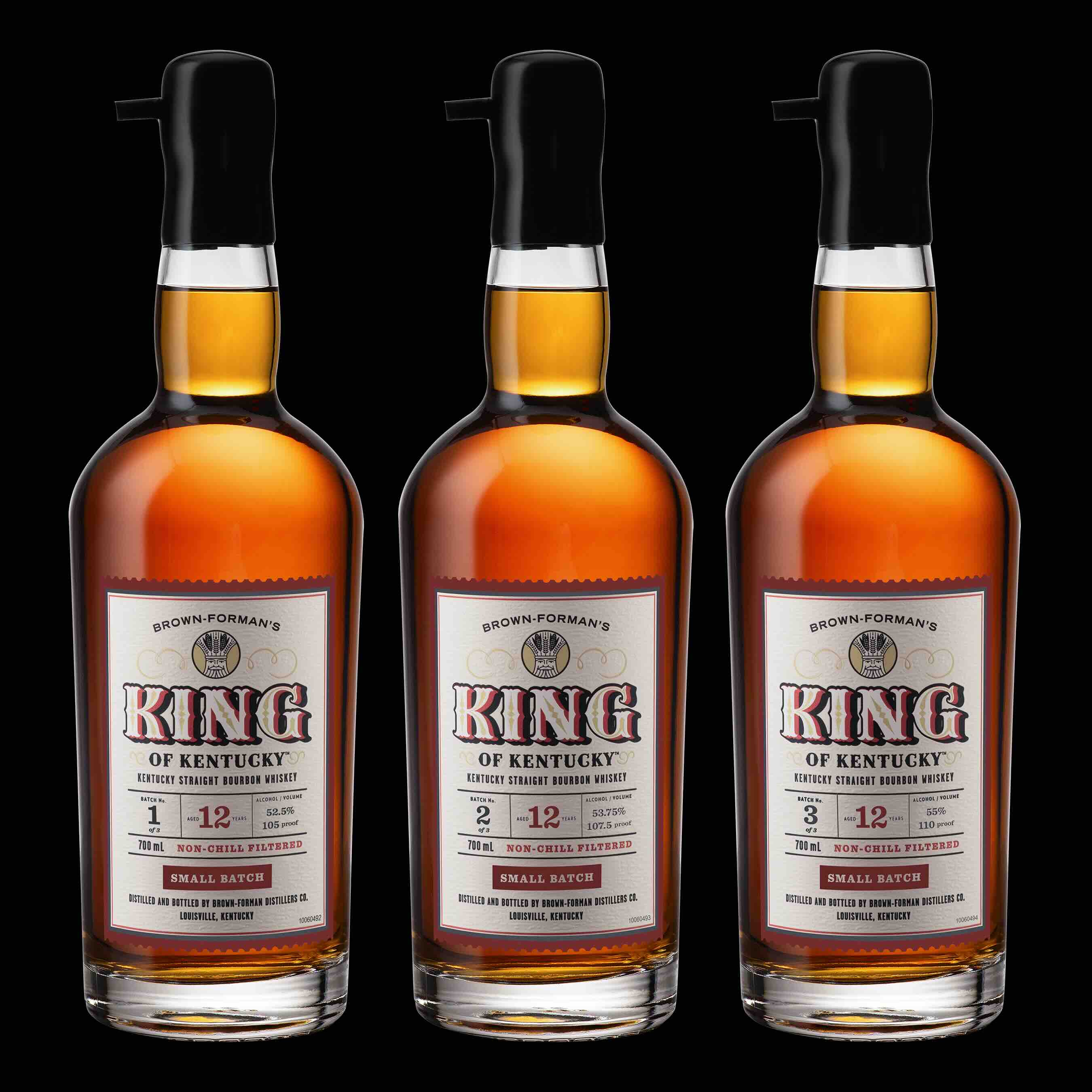
It was a unique site at the Feb. 4 media release of King of Kentucky Bourbon: On a table in the meeting room stood three clusters of KoK bottles, each identically labeled ... except for unique proofs of 105, 107.5 and 110. Since its launch in 2018, this coveted release has been a single barrel unveiled each October. But this wintertime event meant something new was afoot.
Brown-Forman master distiller emeritus and lunchtime emcee, Chris Morris, had some ‘splain’in’ to do. But as is his wont, his presentation began with a brief history lesson. When he asked the group, “What did Patrick Henry do for Kentucky in 1776?” he got crickets.
Our collective ignorance made obvious, Morris broke the silence saying in that year, Henry formally "declared the County of Kentucky" within the state of Virginia. And with the arrival of 2026, the 250th anniversary of that grand act would be celebrated with this early release King of Kentucky Bourbon. Morris called it, “Brown-Forman’s present to Kentucky.”
But what, Mr. Morris, is the story behind those bottles on yonder table ... the different proofs and the 700ml package?
Morris said this year's first-ever early release is a small batch made from 100 barrels of bourbon aged 12 to 18 years. More barrels proofed down would make KoK accessible to more markets, but equally important is those proofs are varied (105, 107.5 and 110). By bottling different proofs, flavors not easily discerned in just one proof for the whole batch would become apparent at specific proofs. For example, you'd taste prominent stone fruit notes at 105, or, say leather at 107.5 and dark and bitter chocolate at 110.
And, as we would find out in our own tasting shortly after, each bottle was vastly different from each other. But back to the history lesson for a moment.
Morris said when Brown-Forman bought KoK in 1936, the bourbon brand's history stretched back to 1881. It's name referred to "the sport of kings," a.k.a. the wildly expensive endeavor known as thoroughbred horse racing. B-F eventually changed the bourbon into a blended whiskey that lived on until its discontinuation in 1968.
Brown-Forman kept the KoK label, though, and 48 years later, it revived it as a single barrel release made from a mash bill of 79% corn, 11% rye and 10% malted barley. That combo was formerly known as the Early Times mash bill, but since the brand was sold to Sazerac about five years ago, Morris now calls it, “The King of Kentucky mash bill.” (And, in case you didn't know, Old Forester's spectacular 1924 release also comes from this mash bill.)
Now, let's revisit the decision to create a small batch. As the search for barrels destined for this year’s KoK single barrel release began, Morris said some very-low-volume barrels sampled got the team thinking: The whiskey was still delicious, but their yields were too small for KoK single barrels. Some contained only 14% of the whiskey entered originally. Blending barrels made more sense.
So, now there’s a new line extension that will deliver more King of Kentucky bottles to 36 markets. (When relaunched in 2018, it was a Kentucky-only release. Since then, the single barrel release expanded to just three markets.)

So, to the tasting portion of the day. Before us were three glasses bearing pours of each proof, and as expected, sensory notes were wide ranging among the whiskey media folk in the room. At our table and listening to our comments was Cole Irvin, senior scientist, whiskey innovation at Brown-Forman. Nodding politely at our many unbidden remarks, he said, “You’re right that there are many aromas and flavors in these; we wanted that variation,” he said. “The goal we all kept in mind was every bottling must have the backbone of the King of Kentucky (single barrel). When you taste any of these three, it’s obvious that they’re different from the single barrel. But there’s no doubt when you taste them, you’re drinking King of Kentucky.”
He was right: no doubt about it. And while these small batch releases won’t change your bourbon drinking life like a KoK single barrel, they are undeniably delicious and do, as Irvin insisted, have the backbone of their single-barrel siblings. They are robust, laden with dark chocolate, tobacco, fresh-ground espresso, dark cherries, abundant spice and a juicy mouthfeel that's not at all dry. That KoK releases aren't tannin bombs never ceases to amaze me.
The Brown-Forman team describes each release this way:
● Batch 1 (105 proof): Sweet aromatics of chocolate, caramel, and toasted marshmallow balanced with dried apricot and clove; smooth oak and toasted coconut on the palate; a silky, shorter finish.
● Batch 2 (107.5 proof): Dark fruit notes of dates and fig layered with caramel and charred oak; minty with hints of vanilla; a longer, crisp finish.
● Batch 3 (110 proof): Rich chocolate and brown sugar brightened by citrus and pine; bold oak and spice on the palate; the longest, oak-forward finish.
Not ironically, my tasting notes in my 2025 KoK single barrel review are highly similar to these notes, as are those in my 2024 and 2023 reviews. What’s so appealing about King of Kentucky is that while mostly traditional bourbon notes are expressed in it, all are turned up to 11. That makes it one my favorite bourbons ever. It’s liquid goodness amplified by time, heat-cycled warehouses and a caretaker’s patience.
No doubt that $299 for a 700ml bottle of this trio is a steep ask. But if you find one and can get it, drink it. You won’t regret it.